
Fumigation & marine / Warehouse
Warehouse fumigation in Dubai
Whole-space treatment for bonded and private warehouses where a storage pest population has established across the building instead of a single consignment, so new stock stops being reinfested on arrival.
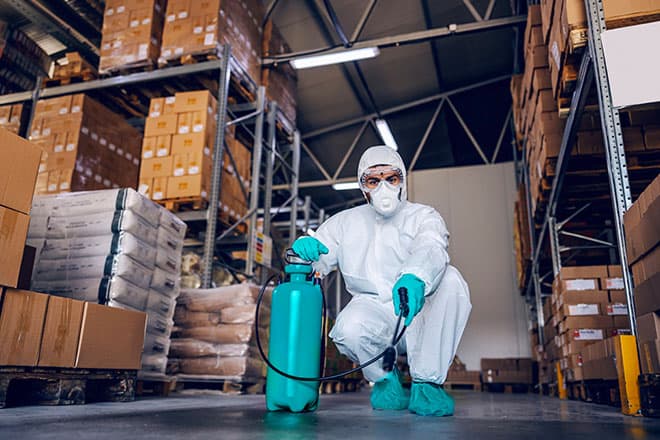
Whole-space treatment
Scheduled around stock movement
Racking, voids and fabric treated
Records for audit and inspection
In short
Warehouse fumigation treats the building as a whole: stock, racking, voids and structure. It is the correct response when new stock becomes infested shortly after arrival, which indicates the reservoir is the building itself.
Overview
When the building is the problem
The clearest sign that a warehouse needs whole-space treatment is new stock becoming infested soon after arrival. That pattern means the population is living in the fabric — spilled product in racking, residue in floor joints, dust in voids — and is colonising each incoming consignment.
Treating consignments one at a time in that situation is endless. Each treated pallet is reinfested by the building, and the cost accumulates without the problem ever resolving.
Whole-space treatment is planned around stock movement, because the space needs to be sealed and held. That takes coordination, which is why it works best scheduled into a quiet period instead of called in as an emergency.
At a glance
- Treats
- Stock, racking, fabric
- Indicates
- New stock infested fast
- Needs
- Space sealed and held
- Scheduling
- Around stock movement
- Output
- Treatment records
What is included
What a warehouse treatment covers
We treat the building, not the consignment. That is the whole point of the exercise.
Survey and source mapping
We identify where the population is actually living — racking, floor joints, voids, dust accumulations and residual spillage — before planning the treatment.
Sealing the space
The building or treatment zone is sealed so the gas is retained for the full exposure. Leakage is the usual cause of a disappointing result.
Stock and racking
Stored goods and the racking they sit on treated together, since separating them simply leaves half the population.
Voids and structure
Roof voids, service ducts, floor joints and cavities treated, because these hold the residues that sustain the population.
Ventilation and clearance
Ventilated and cleared before staff re-enter and before operations resume.
Cleaning schedule
Written recommendations on cleaning, spillage handling and stock rotation, which is what prevents the population rebuilding.
How it works
How a warehouse job is planned
This is planned work. Sealing and holding a building takes coordination with your operation.
- 1SurveyThe building is surveyed for the actual reservoir — racking, voids, floor joints and spillage — and the treatment zone is defined.
- 2Plan around operationsA window is agreed around stock movement and shift patterns, since the space must be sealed and held for the exposure period.
- 3Sealing and treatmentThe zone is sealed and treated, covering stock, racking, voids and structure together.
- 4Exposure and ventilationThe exposure period is held in full, then the space is ventilated and cleared before anyone re-enters.
- 5Records and preventionTreatment records issued for audit, with a written cleaning and stock-handling schedule to stop the population rebuilding.
Who it is for
Warehouse and logistics operators
Whole-space treatment applies where the building itself has become the source.
- Bonded and private warehouses storing food, feed or dried produce
- Logistics operators whose incoming stock is infested shortly after arrival
- Food and FMCG distributors facing audit or customer complaints
- Operators who have treated consignments repeatedly without resolving it
Cost
What whole-space treatment is priced on
Priced against the volume of the building and the time it has to be out of use, because this treats the structure as well as the stock.
Plan it into a quiet period
The building is sealed, treated, ventilated and cleared before anyone goes back in. Scheduled into a quiet window that is manageable; called in as an emergency it is not.
- 01Building volumeDosage is calculated against the space being treated, so height matters as much as floor area.
- 02Stock in placeTreating with racking loaded is different from treating an empty building, and affects both sealing and exposure.
- 03Sealing requiredDoors, vents, roof lights and service penetrations all have to be sealed, and a leaky building takes longer to prepare.
- 04Total out-of-use windowSealing, exposure, ventilation and confirmed clearance together decide how long the building is unavailable.
- 05CoordinationWorking around stock movement and other occupiers is what usually decides when the work can happen.
FAQ
Warehouse questions
The questions customers ask most before booking this service. If yours is not covered, call or message and a technician will answer it.
How do I know if I need whole-space treatment?
If new stock becomes infested shortly after arrival, the reservoir is the building itself. Treating consignments individually in that situation never resolves it.
Do we have to empty the warehouse?
Not usually. Stock and racking are treated together, which is the point. What is required is that the space can be sealed and held for the exposure period.
How long will operations be affected?
It depends on the volume of the space and the exposure required, plus ventilation and clearance afterwards. We confirm the total window at survey so it can be planned around.
When can staff re-enter?
Only after ventilation and confirmed clearance. That confirmation forms part of the service, so your team is never left to judge it.
Will it stay clear afterwards?
Only if the cleaning and stock-handling recommendations are followed. Residual spillage in racking and floor joints is what allows a population to rebuild.
Summary
Key points
- New stock infested soon after arrival means the building is the reservoir.
- Stock, racking, voids and structure are treated together.
- The space must be sealed and held, so it is planned work.
- Clearance is confirmed before staff re-enter.
- Cleaning and stock rotation decide whether it stays clear.
- Survey and quotation are free.
Other fumigation & marine services
- Container Fumigation
- Vessel Fumigation
- Ship Sanitation Certificates
- Agricultural Commodity Fumigation
- Tobacco Fumigation
- Wood Heat Treatment
Not sure which applies? Call +971 55 293 1860 and we will tell you.
Get a warehouse fumigation quote
Tell us the building volume, the stock held and the pattern you are seeing, and we will survey and quote in writing.