
Termite control / Pre-construction
Pre-construction anti-termite treatment in Dubai
A chemical soil barrier applied in stages before and during the pour. It is the only point in a building's life when the entire footprint can be protected at once, and it cannot be retrofitted afterwards.
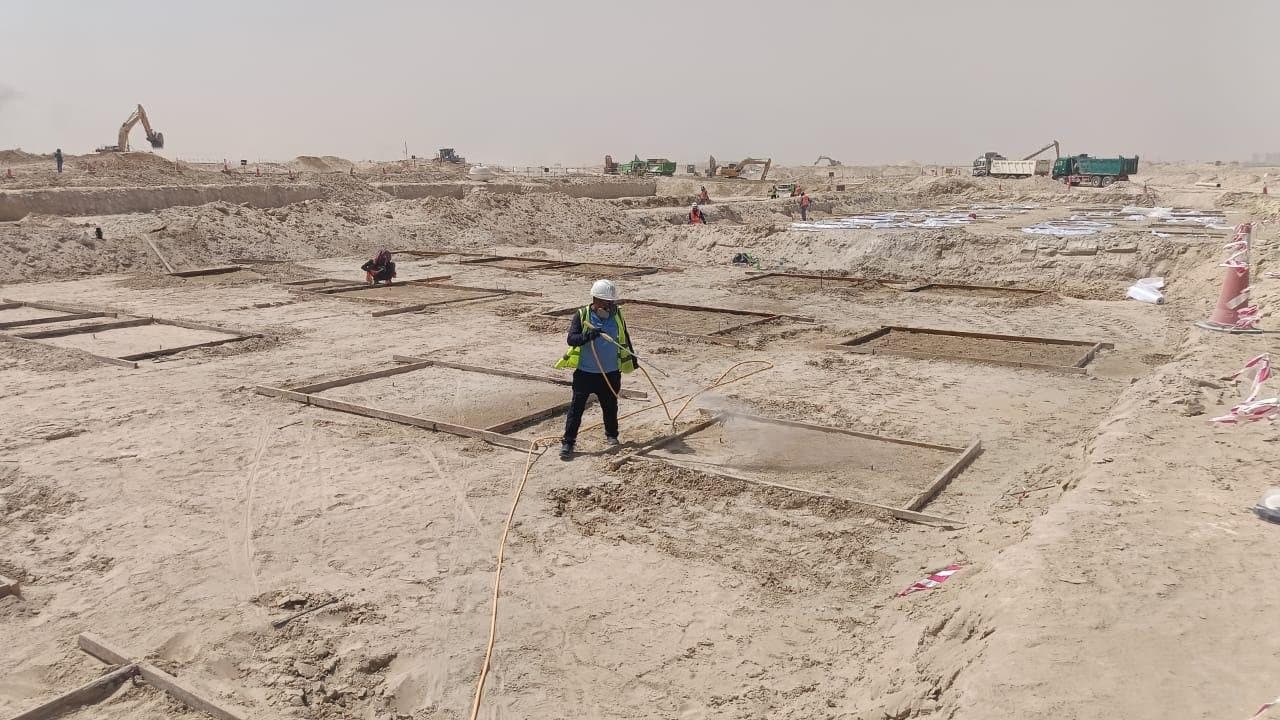
Applied in stages against the build programme
Treatment record issued for each stage
Ministry-registered products
Coordinated with the main contractor
In short
Pre-construction anti-termite treatment applies termiticide to prepared ground in stages: to the excavated base, to the backfill against foundations, and to the final levelled surface before the slab is cast. Each stage is recorded, and the result is a continuous treated zone beneath the finished building.
Overview
Why pre-pour treatment matters in Dubai
Subterranean termites reach a building from the soil, moving up through expansion joints, service penetrations and cracks to reach any cellulose inside — door frames, skirting, wardrobes, stored paper. Dubai's warmth and the moisture around irrigated landscaping give them year-round activity.
Treating the ground before the slab is cast creates a continuous treated zone across the whole footprint. Once the building is finished that zone can only be approximated, by drilling and injecting from above, which is more disruptive and harder to make continuous.
Because the work has to land at specific points in the build programme, it is coordinated with the main contractor across the whole build. Miss the window between levelling and pouring and the opportunity is gone.
At a glance
- When
- Before and during the pour
- Stages
- Typically three
- Coverage
- Whole building footprint
- Records
- Issued per stage
- Retrofit?
- Not possible
What is included
What a pre-construction treatment covers
The structure defines the scope; floor area alone does not. These are the elements treated on a typical project.
Excavated base
Termiticide applied to the prepared base before blinding and reinforcement, establishing the treated zone under the slab.
Foundation backfill
Treatment of the fill placed against foundation walls and pile caps, closing the vertical route up the structure.
Final levelled surface
The last application immediately before the pour, once levelling is complete and before the membrane and reinforcement go down.
Service penetrations
Plumbing, drainage and cable entries treated individually. These are the most common route into a finished building.
Expansion joints
Joint lines treated as part of the zone, since they are a direct path from soil to structure once the building is in use.
Treatment records
A record issued for each stage showing area, product, dilution and date, for the project file and handover documentation.
How it works
How the work is sequenced
Pre-construction treatment is programme work. The sequence below is agreed with the contractor before the first stage.
- 1Programme reviewWe review the build programme and agree the stage dates and access requirements with the main contractor, so treatment lands in the correct window.
- 2Stage one — baseThe excavated and prepared base is treated before blinding. Attendance is confirmed in advance so the following trade is not held up.
- 3Stage two — backfillFill against foundations and pile caps is treated as it is placed, closing the vertical path up the structure.
- 4Stage three — pre-pourThe final levelled surface and all service penetrations are treated immediately before the membrane and reinforcement are laid.
- 5Records and handoverTreatment records for each stage are issued for the project file, and a warranty position is confirmed in writing.
Who it is for
Developers, contractors and self-builders
Pre-construction treatment is specified at design or early works stage. If the slab is already cast, post-construction treatment is the route instead.
- Main contractors delivering residential, commercial and mixed-use projects in Dubai
- Developers who need treatment records in the handover pack
- Villa and self-build projects where the ground is still open
- Extensions and new slabs poured against an existing building
Cost
What a pre-construction quote depends on
Quoted from the drawings and the programme. The area treated and the number of stages drive the figure more than anything else.
The timing point
Specified at design or early works stage this lands inside windows the programme already has. Brought in once the ground is levelled and the pour is booked, it costs the programme time as well as money.
- 01Treated footprintSoil barrier work is measured against the area and the perimeter, so the building's footprint sets the baseline.
- 02Number of stagesTreatment lands at defined points in the build. More stages means more attendances, each coordinated with the main contractor.
- 03Service penetrationsPlumbing, drainage and cable entries are each treated individually, so a heavily serviced slab takes longer.
- 04Site access and programmeWorking around other trades, restricted access and out-of-hours attendance all affect the time on site.
- 05DocumentationStage records for the project file and handover pack are part of the work on any project that will be audited.
FAQ
Pre-construction questions
The questions customers ask most before booking this service. If yours is not covered, call or message and a technician will answer it.
Can pre-construction treatment be done after the slab is poured?
No. Once the slab is cast the ground beneath it is inaccessible. From that point the route is post-construction treatment, which drills and injects from above to approximate the same barrier.
How many stages are involved?
Typically three — the excavated base, the backfill against foundations, and the final levelled surface before the pour — plus individual treatment of service penetrations. The exact sequence follows the structure.
Will it delay our programme?
It should not. Stage dates are agreed with the main contractor in advance and attendance is confirmed ahead of the following trade, because the whole point is to land in an existing window instead of creating a new one.
What documentation do we receive?
A treatment record for each stage showing the area treated, the product, the dilution and the date, suitable for the project file and the handover pack.
Is the treatment safe for site workers?
Products are registered with the UAE Ministry of Climate Change and Environment and applied by trained technicians working to your site rules and permit system. Re-entry guidance is given for each stage.
Does rain or irrigation affect it?
Timing matters. We plan application around weather and any temporary water on site, because heavy wetting immediately after application can affect distribution in the soil.
Summary
Key points
- Pre-construction treatment protects the whole footprint and cannot be retrofitted.
- It is applied in stages timed to the build programme, not as a single visit.
- Service penetrations and expansion joints are treated individually.
- A treatment record is issued per stage for the project file.
- If the slab is already cast, post-construction treatment is the alternative.
- Survey and written quotation are free.
Other termite control services
Not sure which applies? Call +971 55 293 1860 and we will tell you.
Get a pre-construction treatment quote
Send us the programme and the footprint and we will quote the stages, the records and the attendance dates in writing.