
“Star al madina pest control is exceptional! Prompt response, knowledgeable technicians, effective treatments, and excellent customer service. Highly recommend for all your pest control needs.”
Pest control / Mosquitoes
Mosquito control in Dubai
Fogging clears the adults flying tonight and nothing else. Lasting mosquito control means finding and removing the standing water they breed in, then treating the shaded places the adults rest during the day.
Free inspection and written quote
Breeding sites found, not just adults sprayed
Larvicide safe for ponds and water features
Same-day slots across most of Dubai
In short
Mosquito control in Dubai works by removing breeding sites first and treating resting sites second. A technician surveys the plot for standing water — irrigation boxes, drainage chambers, plant saucers, roof drains — applies larvicide where water cannot be drained, then treats shaded vegetation where adults rest during the day.
Reviewed by the Star Al Madina technical teamDubai Municipality licensedLast updated
Overview
Mosquito control for Dubai homes and compounds
Mosquitoes need standing water to breed, and in Dubai that water is nearly always man-made. Irrigation systems, drainage chambers, plant pot saucers, ornamental features, air-conditioning condensate trays, uncovered tanks and blocked roof outlets all hold enough water for a generation to complete. A bottle cap's worth is sufficient for some species.
The life cycle is short — roughly seven to ten days from egg to biting adult in Dubai's temperatures — which is why fogging on its own never holds. Killing the adults present on the day leaves the larvae in the water untouched, and they emerge within the week.
Star Al Madina treats mosquitoes across Dubai villas, compounds, landscaped developments, labour accommodation and construction sites. The inspection maps every water source on the plot first, because that survey separates a treatment that lasts from one that buys you a quiet weekend.
At a glance
- Main method
- Larviciding plus residual
- Vacate?
- Not for standard treatment
- Life cycle
- 7–10 days egg to adult
- Key factor
- Standing water on the plot
- Follow-up
- Included
Identification
Signs you have a mosquito problem
Bites tell you there are adults. What tells you where they are coming from is water, and it is usually closer to the building than people expect.
Bites at dawn and dusk
Most species feed heaviest in the hours around sunrise and sunset, and concentrate near shaded outdoor seating and garden areas.
Larvae in standing water
Small comma-shaped larvae wriggling at the surface of any container, chamber or saucer that has held water for more than a few days.
Adults resting in shade
Mosquitoes spend the day on cool shaded surfaces — dense shrubs, under decking, in garages, behind external units and in drainage chambers.
Activity near irrigation
Concentrated biting around drip lines, valve boxes and planted beds, particularly where irrigation runs longer than the soil can absorb.
Problems after rain
A noticeable rise five to ten days after rainfall, as water trapped in trays, covers and blocked outlets completes a breeding cycle.
Indoor mosquitoes at night
Insects coming in through unscreened windows and gaps around AC units, usually from a breeding site within about a hundred metres.
Health and risk
Are mosquitoes dangerous?
Mosquitoes are the most medically significant insect group worldwide. The UAE has strong surveillance and is not a malaria-endemic country, but the species capable of transmitting disease are present and the risk is managed, not absent.
Disease vectors
Aedes and Culex species are recognised vectors for dengue, chikungunya and West Nile virus. UAE health authorities maintain active surveillance and control programmes.
Allergic reactions
Bite reactions range from a small welt to significant swelling. Scratching broken skin in humid conditions readily leads to secondary infection.
Loss of outdoor space
For villas and compounds the practical harm is that gardens, terraces and pool areas become unusable at exactly the times of day they are wanted.
Risk to a site or business
Labour accommodation and construction sites have a duty of care, and standing water on site is both a mosquito source and an inspection finding.
Species
Which mosquito you have changes the treatment
CHECK WITH TECHNICIANSWhere a species breeds and when it bites determines where we treat and at what time. Getting this wrong means treating an empty garden at the wrong hour.
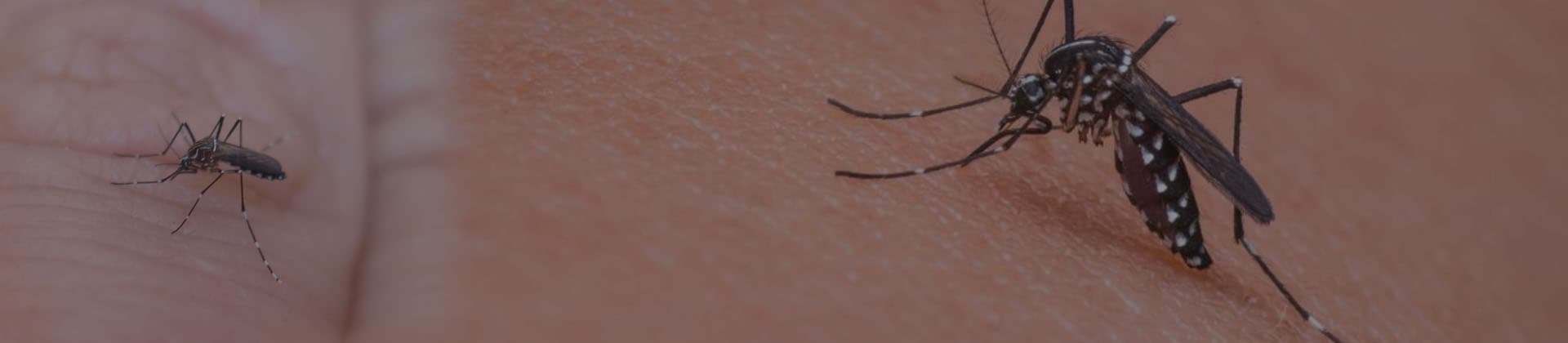
Asian tiger mosquito
Aedes albopictus · 4–6mm
Black with distinctive white banding on the legs. A daytime biter that breeds in very small artificial containers — plant saucers, tyres, buckets, bottle caps. Container removal matters more than spraying for this species.
Common house mosquito
Culex quinquefasciatus · 4–7mm
Pale brown and the usual night-biting mosquito indoors. Breeds in organically rich standing water — drainage chambers, blocked gullies, septic overflow and stagnant irrigation boxes, seldom clean containers.
Anopheles mosquitoes
Anopheles spp. · 5–8mm
Recognisable by the resting posture, with the body angled away from the surface. Breeds in clean, still or slow-moving water. Present in the region and monitored, which is why standing clean water is treated seriously.
Our treatment
How we treat mosquitoes
Source reduction first, larvicide where water cannot be removed, residual treatment on resting sites, and fogging only where an immediate knockdown is genuinely needed.
Why not just fog the garden?
Fogging kills the adults airborne at that moment and leaves no residual. The larvae in the irrigation box are untouched and emerge within the week. It is a useful tool before an event, not a control programme.
- 1Breeding site surveyWe walk the plot and check irrigation valve boxes, drainage chambers, plant saucers, water features, roof outlets, AC condensate trays, tanks and any container holding water.
- 2Source reductionWater that can be drained, emptied, covered or drilled to drain is dealt with physically. This is the most effective single action and it costs nothing to maintain.
- 3LarvicidingWhere water must stay — chambers, ponds, tanks, ornamental features — we apply a larvicide that stops development. Formulations suitable near fish and wildlife are used where relevant.
- 4Residual on resting sitesA residual barrier applied to shaded vegetation, under decking, wall bases and the undersides of foliage where adults rest during the day.
- 5Follow-up visitWe re-survey for new water, reapply larvicide where it has expired, and confirm the biting pressure has actually dropped instead of moving.
Comparison
Larviciding, residual barrier or fogging?
Three tools with very different durations. The mix depends on how much standing water the plot carries.
| Method | Best for | Vacate? | How long it lasts |
|---|---|---|---|
| Larviciding | Water that cannot be drained — chambers, tanks, ponds, irrigation boxes | No | Weeks per application, product dependent |
| Residual barrier | Shaded vegetation and resting sites around outdoor living areas | A short drying period | Several weeks, reduced by irrigation and rain |
| ULV fogging | Immediate knockdown before an event, or a heavy adult population | Yes, for a stated period | Hours. No residual effect at all |
Fogging is the most visible treatment and the least durable. We use it as a supplement where adult numbers are high, never as the whole programme.
Cost
What affects the cost
We price the job once we have walked the plot, because the plot decides the work. The inspection and the quote are both free, and the price is fixed in writing before anything starts.
One thing worth knowing
If the breeding site is in shared landscaping, a neighbouring plot or a community drainage chamber, treating your garden alone will not hold. Mosquitoes readily fly a hundred metres or more.
- 01Size of the plotGarden area, planted beds and the length of the perimeter determine how much residual treatment is needed and how long the survey takes.
- 02Number of water sourcesA villa with irrigation valve boxes, a water feature, a pool surround and roof drainage has many more treatment points than a balcony.
- 03AccessibilityDrainage chambers under paving, roof outlets and covered tanks all take longer to reach and to treat properly.
- 04Whether fogging is includedFogging adds cost and requires the area to be vacated for a stated period. It is quoted separately because it is optional.
- 05Home, compound or siteCompounds, labour accommodation and construction sites are quoted on a scheduled programme with documented records behind each visit, never as a one-off.
Before the visit
What you need to do
The preparation for mosquito work is mostly about giving us access to water you may not think of as water.
- Unlock or point out irrigation valve boxes, drainage chambers, roof access and any water tank or feature.
- Empty plant saucers, buckets, toys and containers holding water, and tip out anything that has stood for more than a few days.
- Tell us about fish, ponds, pets or anyone with asthma. It changes the larvicide and the application method.
After the visit
What to expect
- Biting usually drops within a day or two where adults were the main problem, and over one to two weeks where breeding was.
- Do not refill or re-cover treated chambers and features until the technician says the larvicide has settled.
- Avoid washing down treated vegetation and wall bases, which removes the residual barrier early.
- Re-check saucers, buckets and covers weekly. New water is how a treated plot becomes an untreated one.
Timeline
How long until the mosquitoes are gone?
Adults respond quickly; the breeding cycle takes a week or so to work through. Both timelines run at once.
Day 0
Treatment
Plot surveyed, standing water drained or larvicided, residual applied to resting sites, and the water sources found written into the report.
Days 1–3
Adults drop off
Biting pressure falls as adults contact the treated resting surfaces. Outdoor areas usually become usable in this window.
Days 4–10
The cycle breaks
Larvae already in treated water fail to develop. This is the period where the problem would otherwise have rebuilt.
Around day 14
Follow-up visit
We re-survey for new water, reapply where larvicide has expired and treat anything that has appeared since.
Ongoing
Seasonal pressure
Numbers rise after rain and through the humid months. Compounds and villas with irrigation usually run a scheduled programme.
Prevention
How to keep mosquitoes from coming back
Mosquito prevention is water management. Nothing here clears tonight's adults, but it decides whether there are more next week.
Empty standing water weekly
Plant saucers, buckets, toys, wheelbarrows and covers. A container holding water for a week is a completed breeding cycle.
Keep drains and gullies clear
Blocked roof outlets, balcony drains and yard gullies hold organically rich water, which is exactly what Culex species prefer.
Check irrigation valve boxes
Sunken valve boxes hold water after every cycle and are the single most commonly missed breeding site in Dubai villas.
Cover tanks and features
Water tanks, ornamental features and unused pools need sealed covers or continuous circulation. Still water is the requirement, not dirty water.
Fit and repair screens
Intact screens on windows and gaps sealed around air-conditioning units keep the adults outside where the barrier treatment works.
Thin dense shaded planting
Adults rest in cool dense foliage during the day. Thinning it removes the harbourage and makes any barrier treatment more effective.
Across Dubai
Where the problem comes from depends on where you live
Mosquitoes fly, so the source is often not on the property being bitten. The building type changes where we look first.
Apartments and towers
Dubai Marina · JLT · Business Bay · International City
Breeding is usually in shared areas — podium landscaping, drainage chambers, roof outlets and blocked balcony drains — seldom in individual flats. Effective control means treating the common areas through building management.
Villas and compounds
Al Barari · Emirates Hills · The Lakes · Palm Jumeirah
Irrigation valve boxes, water features, pool surrounds and planted beds are the usual sources, and dense shaded planting gives the adults somewhere to rest. This is where a full plot survey pays for itself.
Sites and accommodation
Al Quoz · Jebel Ali · Dubai Industrial · Ras Al Khor
Excavations, trenches, stored materials and temporary drainage hold water on construction sites, and labour accommodation carries a duty of care. Both run on scheduled programmes with documented records.
Reviews
What customers say
Verbatim from Google.
“On schedule, the pest treatment team sprayed the bathroom and behind the sink, where the majority of my pests were hiding.”
“Its really good pest control services in uae with professional team work keep it !! I am satisfy with their work”
FAQ
Mosquitoes questions
The questions customers ask most before booking. If yours is not covered here, call or message us and a technician will answer it.
Why do the mosquitoes come back after fogging?
Fogging kills the adults in the air at that moment and leaves no residue. The larvae in standing water are untouched and emerge within about a week. Lasting control needs the breeding sites dealt with as well.
Where are they breeding if I have no pond?
Almost always in something small and man-made: irrigation valve boxes, plant saucers, drainage chambers, air-conditioning condensate trays, roof outlets and covers. Some species need no more than a bottle cap of water.
Is the treatment safe for fish and pets?
Yes, when the right product is chosen. Tell us at booking about ponds, fish, pets or anyone with asthma, and we select larvicide formulations and application methods suitable for those conditions.
Do I need to leave the property?
Not for larviciding or residual barrier treatment. Fogging does require the area to be vacated for a stated period, and you get that at the point of booking, never on the day.
How long does the treatment take?
A villa plot survey and treatment usually takes one to two hours, because the survey is the substantial part. Apartments and balconies are quicker; compounds and sites are scheduled by area.
How should I prepare for the visit?
Give us access to irrigation valve boxes, drainage chambers, roof outlets and any tank or water feature, and empty obvious containers. Tell us about fish, pets and health conditions at booking.
Can I water the garden afterwards?
Normal irrigation is fine, but avoid washing down treated vegetation and wall bases, which strips the residual barrier early. The technician will point out the treated surfaces.
My neighbours have them too. Does that matter?
Yes. Mosquitoes readily fly a hundred metres or more, so a breeding site in a neighbouring plot or a community drainage chamber will keep reinfesting a treated garden. Community-level treatment is far more effective.
Do you treat construction sites and accommodation?
Yes. Both run on scheduled programmes with documented service records, covering standing water in excavations and temporary drainage as well as the accommodation blocks themselves.
When is mosquito season in Dubai?
Mosquitoes are active year-round here, with pressure rising in the humid months and for a week or two after rainfall. Villas and compounds with irrigation typically run a scheduled programme instead of one-off visits.
Summary
Key points
- Fogging kills tonight's adults and nothing else — the larvae emerge within the week.
- Standing water on the plot is the actual problem, and it is usually man-made.
- Irrigation valve boxes are the most commonly missed breeding site in Dubai villas.
- Larvicide formulations suitable for ponds and fish are used where relevant.
- Mosquitoes fly far enough that a neighbouring source will reinfest a treated garden.
- Inspection and the written quote are free.
Book a free mosquito inspection
We will survey the plot for standing water and tell you where they are actually breeding before quoting anything.