
Construction site services / Site mosquito control
Mosquito control on construction sites in Dubai
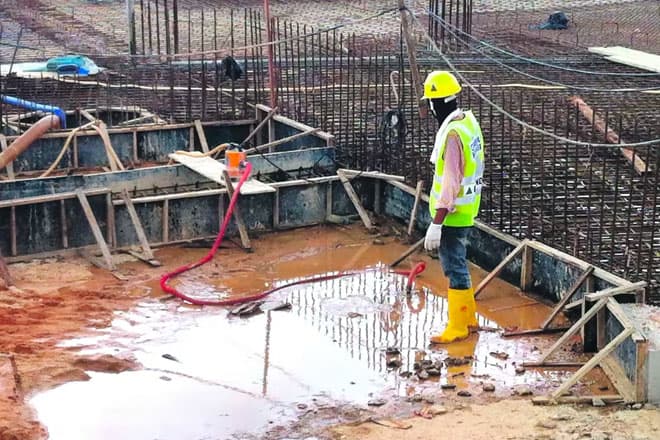
Standing water in excavations, trenches, temporary drainage and curing areas is the source. The programme finds and treats that water instead of fogging the perimeter every week.
Scheduled against the build programme
Service records for the project file
Site induction and permit compliance
Out-of-hours attendance available
In short
Site mosquito control surveys the works for standing water — excavations, trenches, temporary drainage, curing areas, tanks and stored materials — then larvicides what cannot be drained and treats adult resting sites. With a seven to ten day breeding cycle, source control is the only approach that holds.
Overview
Why sites breed mosquitoes
Construction generates standing water continuously. Excavations and trenches fill, temporary drainage ponds, curing water collects, tank bases and stored materials hold rainwater, and every one of those is a breeding site in a climate where the cycle completes in about a week.
That short cycle is why fogging alone fails on site. Killing the adults on a Thursday leaves the larvae in the trench untouched, and a new generation is biting by the following week. The water is the problem.
There is also a duty-of-care dimension. Labour accommodation adjacent to a breeding site puts the workforce under sustained biting pressure, and standing water on site is an inspection finding in its own right.
At a glance
- Method
- Source control plus larvicide
- Cycle
- 7–10 days on site
- Focus
- Excavations and drainage
- Fogging
- Supplement only
- Records
- Per visit
What is included
What the mosquito programme covers
The survey is the substantive part. Treatment follows the water.
Excavations and trenches
Open ground holding water after rain, dewatering or works, checked and treated at every visit as the site changes.
Temporary drainage
Site drainage, sumps, settlement tanks and pumping arrangements, which pond and hold organically rich water.
Curing and wash-down water
Water used in concrete curing and plant wash-down areas, which collects and stands long enough to breed.
Stored materials
Pipes, tanks, formwork, tyres and containers holding rainwater — the most commonly overlooked source on any site.
Larviciding
Applied where water cannot be drained, breaking the cycle before adults ever emerge.
Welfare protection
Residual treatment of resting sites around accommodation and messing areas, where the biting pressure is actually felt.
How it works
How the programme runs
Because site water moves and changes, the survey is repeated at every visit.
- 1Baseline water surveyThe works are walked and every standing water source mapped — excavations, drainage, curing areas, tanks and stored materials.
- 2Source reductionWater that can be drained, pumped, covered or drilled to drain is dealt with physically, and the actions are recorded for the site team.
- 3LarvicidingWater that must remain is larvicided, with product chosen for the setting and the volume involved.
- 4Welfare treatmentResidual treatment around accommodation and messing areas so the workforce is protected while source control takes effect.
- 5Repeat survey each visitSite water changes weekly. Every visit re-surveys and treats new sources, which is what stops the cycle restarting.
Who it is for
Main contractors and site management
Mosquito programmes matter most where the workforce is accommodated on or near the works.
- Sites with excavations, dewatering or extensive temporary drainage
- Projects with labour accommodation on or adjacent to the works
- Infrastructure and civils projects with long open-ground phases
- Sites where standing water has been raised at inspection
Cost
Priced on the water, not the area
The survey is the substantial part of this work, so the number of water sources on site drives the price more than the site footprint does.
Why fogging alone is the expensive option
Fogging the perimeter every week treats the adults flying that evening and nothing else. Finding and treating the water is less frequent work and it actually holds.
- 01Number of water sourcesExcavations, trenches, temporary drainage, curing areas, tanks, formwork and stored containers each hold water and each has to be found.
- 02How often the survey repeatsSite water moves and changes, so the survey is repeated at every visit. A fast-moving site needs that more often.
- 03Accommodation on or near siteWhere the workforce is accommodated close to the works, the programme matters more and usually runs at a higher frequency.
- 04SeasonPressure rises through the humid months, and programmes are normally stepped up rather than left flat across the year.
- 05DocumentationRecords of sources found and treated per visit go into the project file.
FAQ
Site mosquito control questions
The questions customers ask most before booking this service. If yours is not covered, call or message and a technician will answer it.
Why does fogging not work on its own?
Because it kills only the adults flying at that moment. Larvae in the trench or the drainage sump are untouched and emerge within a week. On site the water is the problem, not the adults.
What are the usual breeding sites on a site?
Excavations and trenches, temporary drainage and sumps, curing and wash-down water, tank bases, and stored pipes, tyres, formwork and containers holding rainwater.
How often do you need to attend?
Site water changes weekly, so visits are frequent enough to re-survey and treat new sources. The interval is set at the baseline survey and adjusted by phase.
Is larvicide safe to use on site?
Products are chosen for the setting and the water volume, and are registered with the UAE authorities. Where water is being discharged or reused, tell us and the product is selected accordingly.
Does this cover the accommodation as well?
Yes. Resting sites around accommodation and messing areas are treated so the workforce is protected while source control takes effect on the works.
Summary
Key points
- The breeding cycle completes in about a week, so fogging alone never holds.
- Excavations, temporary drainage and stored materials are the usual sources.
- Water that cannot be drained is larvicided instead.
- The survey is repeated every visit because site water changes weekly.
- Accommodation and messing areas are treated so the workforce is protected.
- Survey and quotation are free.
Other construction site services services
Not sure which applies? Call +971 55 293 1860 and we will tell you.
Get a site mosquito control quote
Tell us the site phase, the drainage arrangements and where the accommodation sits and we will survey and quote.